Year three has covered our first go-around of early modern history, roughly the period of time from Elizabeth the I to 1850. We used The Story of the World, Volume Three, both the text and the workbook, with a bit of overlap from volume two. However, I really dislike the way the chapters are organized, so before we started I re-ordered everything. Mainly I just re-ordered the chapters, but in some places I even split chapters into their separate sections, and there is even a place where I just moved one page. It was a pain, but worth it to have the flow make more logical sense to me. I like to work in geographical areas start to finish, not just chronologically while jumping around the globe, and have related events flow together. If there is someone else out there who also doesn't love Story of the World, but still wants to use it because it's pretty kid and parent-teacher friendly, who can use this info, it will be all the more worth it. We also supplement with the Usborne Internet Linked Encyclopedia of World History (UILE).
Each week we covered an area/topic. We do history work roughly three days a week (it's all flexible), and each day takes us roughly a hour, sometimes more if we find interesting documentaries or books, sometimes less if it's a less full or interesting subject.
Our weekly schedule this year went like this:
Monday - Read chapters of text, answer questions from activity book, complete map-work pages from activity book
Tuesday - Look at any related websites and watch related Youtube videos, read related pages of UILE, write a timeline page of 3-4 most important dates
Thursday - Read related library books, dictate out a "narration page" (a summary of the information learned for the week's topic)
Our week's topics, with chapters from Story of the World, went like this:
Week 1 - Review Middle Ages
Chapter 42 (Story of the World, Volume 2)
Week 2 - Middle East
Chapter 8, 18 (Story of the World, Volume 3)
Week 3 - India
Chapter 11, 19
Week 4 - Japan
Chapter 5, 10 (section - Japan's Isolation: Closed Doors in the East)
Week 5 - China
Chapter 10 (section - The Foreign Conquest of China: The Rise of the Manchu), 20
Week 6 - China (con't)
Chapter 28, 39
Week 7 - Australia and New Zealand
Chapter 24, 41
Week 8 - Africa
Chapter 7, 37
Week 9 - Germany
Chapter 1 (section - The Holy Roman Empire), 9, 14
Week 10 - Russia
Chaper 17, 26
Week 11 - France
Chapter 13
Week 12 - Canada/France
Volume 2, Chapter 41
Volume 3, Chapter 4, 15 (section - War Against the Colonies)
Week 13 - Spain
Volume 2, Chapter 42
Chapter 1 (section - The Riches of Spain)
Week 14 - Dutch
Chapter 2 (section - Dutch Revolt), 6 (section - Dutch in the New World)
Week 15 - Mary/James
Chapter 2 (section - Queen is a Country), 3, 7 (section - Tobacco and Unwilling Colonists)
Week 16 - Cromwell and Enlightenment
Chapter 12, 16
Week 17 - Colonies
Chapter 6 (section - New Colonies in the New World), Chapter 15 (sections - A New World in Conflict, William Penn's Holy Experiment)
Week 18 - Birth of America
Chapter 21, 22 (section - Discontent in the British Colonies)
Week 19 - Birth of America (con't)
Chapter 22 (section - The American Revolution), 23
Week 20 - French Revolution
Chapter 25, 29
Week 21 - Napoleon and Haiti
Chapter 33, 30
Week 22 - Industrial Revolution
Chapter 27, 31
Week 23 - South America
Chapter 34, 35
Week 24 - Westward Expansion
Chapter 32, page 312 (War of 1812), 38 (section - The Trail of Tears)
Week 25 - Slavery
Chapter 36, 38 (section - Nat Turner's Revolt)
Week 26 - Manifest Destiny
Chapter 40, 42
Now that we've powered through that comes the real fun! We haven't done any of the projects in the Activity Book, so we're going to spend the next few weeks reviewing and doing all sorts of projects. We're re-reading the lovely narration and timeline pages we've written over the last 26 weeks (well, it's been longer than that due to breaks of course), looking at the review cards at the back of the Activity Book, and doing whatever projects we like. I'm pretty sure we'll mostly be doing anything involving food. :)
This hasn't been perfect, but has gone much better than history last year, when I used Story of the World, Volume 2, doing just a chapter a week in the order written. Not only was I confused by the way the book was organized, but 40+ weeks was way too long, and I ended up feeling like some topics got too much time and others not enough.
Just one more year, modern history, and we get to start the whole rotation over again!

Showing posts with label homeschool. Show all posts
Showing posts with label homeschool. Show all posts
Tuesday, June 10, 2014


Saturday, May 11, 2013
Teaching Homeschool History - The First Year
As promised, I'm going to do a handful of homeschool posts grouped by school subject to kind of outline how we cover them. Remember, this is just what we do or have done so far. It's not meant for everyone, and the process is evolving for us as well. I'm still pretty new to all this, with The Big One just being seven, so I'm learning as I go along. Still, if you're a new homeschooler or want-to-be homeschooler, or just curious, and it helps you to see how other people plan and organize their homeschool days, feel free to read on.
I mentioned in my last post, How do you homeschool? Part 3 - A method to the madness, that history is the backbone of our studies. I also mentioned that we loosely follow the plan outlined in the book A Well Trained Mind, which divides history into four chronological sections. Right now we're in the middle of going through the sections the first time on a basic level. Then we will repeat them again on a more detailed level, and finally once more on a deep and analytical level. At least that's the idea. So far we've covered ancient history, and are now most of the way through Medieval history (or, the period from the fall of Rome to the start of the Renaissance). Next year we will cover Renaissance to early modern history, and then modern history the year after.
To prepare for learning ancient history in 1st grade, we started with pre-history as one of our last topics in kindergarten. At the time, like many 5 year-old boys, The Big One had an interest in dinosaurs. We had just finished spending some time on the basics of the solar system, as he also had an interest in space.
To transition from space to dinosaurs, we talked about the birth of the Earth and geologic time. Along with basic level books from the library and videos online, we printed, read, and illustrated the mini-books from this website - http://www.fossils-facts-and-finds.com/montessori_materials.html. We talked about the creatures of the late Permian period forward and proceded chronologically, giving a really super basic discussion of evolution as we went. Much of what we learned at the end of the kindergarten year falls on the line between what's considered "science" vs what's considered "history", but again this was just a kindergarten level set-up.
Clearly, we are secular homeschoolers. I recognize that some families wouldn't find these topics acceptable or desirable in their curriculum.
The Big One really loves movies and generally watches with interest, even if things are beyond his scope of understanding, so we watched BBC's "Walking with Monsters" series, then "Walking with Dinosaurs" and "Walking with Beasts". For language arts, we read from whatever applicable books we could find at the library. The Big One practiced his reading skills in books from the I Can Read series like Beyond the Dinosaurs, The Day the Dinosaurs Died, and After the Dinosaurs, as well as the Pre-level 1 DK Reader Meet the Dinosaurs. He practiced writing by keeping a list of all the dinosaurs he read about, along with what era they were from and whether they were omnivore, carnivore, or herbivore. In math, he made a chart of the numbers of dinosaurs he encountered from each time period and made bar graphs of the dinosaurs he read about by period and diet.
Eventually, this all lead to man. We watched the History Channel special "Ape to Man" as well as BBCs "Walking with Cavemen". We also took a family field trip to the Smithsonian Natural History Museum in Washington DC to see all the things we read and learned about up close.
That's where we stood as we started ancient history for 1st grade. I was lucky in that The Big One was a fast and eager learner, even in kindergarten, and was willing to do things when I asked for the most part. With The Little One doing kindergarten next year, I'm sure I'm going to have to come up with a very different plan.
Starting in 1st grade, we got into more of a formalized schedule. I put a lot of time over the summer before 1st grade in planning out how I wanted things to go. Key word being "wanted". I decided on three days a week of history, to be done on Monday, Tuesday, and Thursday, with roughly an hour or so devoted to history each of those days.
While completing history work three times a week, we had general goals or tasks we were to complete for each day of the week.
On Monday, we would introduce the topic. These are the notes I made to myself in my planner:
Monday, introduction day, would usually start with a discussion of the geographical location we were reading about. The Kingfisher book includes a lot of great maps, and of course there are always maps and graphics online. This means we don't cover geography as a separate subject. "History" for us is really more like "social studies". We cover history, geography, religion, and politics all together as one. This makes logical sense to me as all of those topics are really linked closely together.
Continuing with our Monday plan - Once we understood what area of the world we were talking about, I'd skim some of the pages in Kingfisher and we'd look at the pictures and captions. The Usborne History Encyclopedia is pretty simple and to the point, so we'd usually go ahead and read the corresponding pages of that on Monday. The sentences in the captions are especially easy to read, and The Big One would ask to read them out loud as his contribution to the reading. After reading, if I'd found a video on the topic, we'd watch that. There are tons of videos available online but of course they require adult previewing before showing students. I just this year found this mom's blog where she links to all the videos she found for her history topics. It is a great resource. Before I found this I searched for everything on my own, hopefully in advance though sometimes I didn't plan as well.
After reading and videos, I'd print out a small map of the area we were discussing and have The Big One cut and paste it to a sheet of lined paper. Together we'd pick out three dates of importance from what we read, and he would write them, timeline style, on his paper. This served as writing practice, as well as helping to keep things in chronological context.
Tuesday was reading day. Here are my Tuesday notes:
I mentioned in my last post, How do you homeschool? Part 3 - A method to the madness, that history is the backbone of our studies. I also mentioned that we loosely follow the plan outlined in the book A Well Trained Mind, which divides history into four chronological sections. Right now we're in the middle of going through the sections the first time on a basic level. Then we will repeat them again on a more detailed level, and finally once more on a deep and analytical level. At least that's the idea. So far we've covered ancient history, and are now most of the way through Medieval history (or, the period from the fall of Rome to the start of the Renaissance). Next year we will cover Renaissance to early modern history, and then modern history the year after.
To prepare for learning ancient history in 1st grade, we started with pre-history as one of our last topics in kindergarten. At the time, like many 5 year-old boys, The Big One had an interest in dinosaurs. We had just finished spending some time on the basics of the solar system, as he also had an interest in space.
 |
| His first science fair project. |
To transition from space to dinosaurs, we talked about the birth of the Earth and geologic time. Along with basic level books from the library and videos online, we printed, read, and illustrated the mini-books from this website - http://www.fossils-facts-and-finds.com/montessori_materials.html. We talked about the creatures of the late Permian period forward and proceded chronologically, giving a really super basic discussion of evolution as we went. Much of what we learned at the end of the kindergarten year falls on the line between what's considered "science" vs what's considered "history", but again this was just a kindergarten level set-up.
Clearly, we are secular homeschoolers. I recognize that some families wouldn't find these topics acceptable or desirable in their curriculum.
The Big One really loves movies and generally watches with interest, even if things are beyond his scope of understanding, so we watched BBC's "Walking with Monsters" series, then "Walking with Dinosaurs" and "Walking with Beasts". For language arts, we read from whatever applicable books we could find at the library. The Big One practiced his reading skills in books from the I Can Read series like Beyond the Dinosaurs, The Day the Dinosaurs Died, and After the Dinosaurs, as well as the Pre-level 1 DK Reader Meet the Dinosaurs. He practiced writing by keeping a list of all the dinosaurs he read about, along with what era they were from and whether they were omnivore, carnivore, or herbivore. In math, he made a chart of the numbers of dinosaurs he encountered from each time period and made bar graphs of the dinosaurs he read about by period and diet.
 |
| A list of dinosaurs. |
Eventually, this all lead to man. We watched the History Channel special "Ape to Man" as well as BBCs "Walking with Cavemen". We also took a family field trip to the Smithsonian Natural History Museum in Washington DC to see all the things we read and learned about up close.
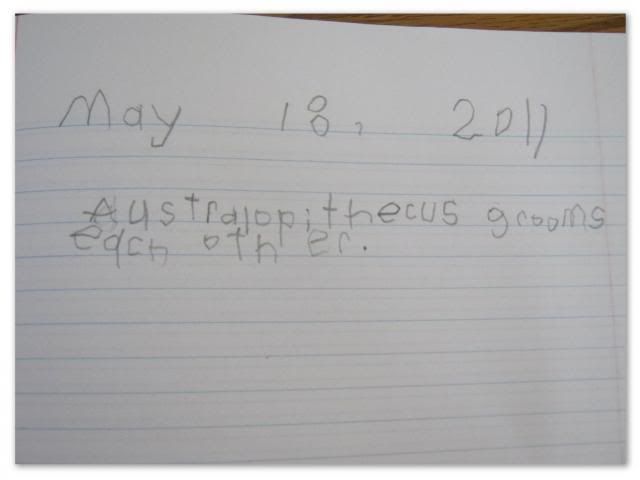 |
| His kindergarten work was much beyond the level of my own. |
That's where we stood as we started ancient history for 1st grade. I was lucky in that The Big One was a fast and eager learner, even in kindergarten, and was willing to do things when I asked for the most part. With The Little One doing kindergarten next year, I'm sure I'm going to have to come up with a very different plan.
Starting in 1st grade, we got into more of a formalized schedule. I put a lot of time over the summer before 1st grade in planning out how I wanted things to go. Key word being "wanted". I decided on three days a week of history, to be done on Monday, Tuesday, and Thursday, with roughly an hour or so devoted to history each of those days.
For our core history texts, I bought copies of
The Kingfisher Book of the Ancient World and The Usborne Encyclopedia
of World History. I divided up the Kingfisher book into about 40 weeks
of lessons*, grouped loosely by geographic area. These books were supplemented by whatever I could find on the subject in the library, plus websites and sometimes videos online or on Netflix.
(*Side
note - How many weeks you out spend of the year "doing school" depends on your
local homeschooling laws and how how you want to organize or not organize things. I prefer to
pretty much work through the summer, and take weeks off whenever we want or
need to throughout the year instead of one long "summer break". We take weeks off for holidays, birthdays, vacations, etc. Other people may prefer to follow the
public school calendar, while still others probably do fewer weeks
of school overall. It's up to what's best for you, your student, and your
family.)
While completing history work three times a week, we had general goals or tasks we were to complete for each day of the week.
"History subject introduction
-discuss what we will be covering this
week
-give basic overview
-watch video on topic, if available
-start reading books on topic, if
available
Map and Timeline page
-see example in history notebook"
Monday, introduction day, would usually start with a discussion of the geographical location we were reading about. The Kingfisher book includes a lot of great maps, and of course there are always maps and graphics online. This means we don't cover geography as a separate subject. "History" for us is really more like "social studies". We cover history, geography, religion, and politics all together as one. This makes logical sense to me as all of those topics are really linked closely together.
Continuing with our Monday plan - Once we understood what area of the world we were talking about, I'd skim some of the pages in Kingfisher and we'd look at the pictures and captions. The Usborne History Encyclopedia is pretty simple and to the point, so we'd usually go ahead and read the corresponding pages of that on Monday. The sentences in the captions are especially easy to read, and The Big One would ask to read them out loud as his contribution to the reading. After reading, if I'd found a video on the topic, we'd watch that. There are tons of videos available online but of course they require adult previewing before showing students. I just this year found this mom's blog where she links to all the videos she found for her history topics. It is a great resource. Before I found this I searched for everything on my own, hopefully in advance though sometimes I didn't plan as well.
After reading and videos, I'd print out a small map of the area we were discussing and have The Big One cut and paste it to a sheet of lined paper. Together we'd pick out three dates of importance from what we read, and he would write them, timeline style, on his paper. This served as writing practice, as well as helping to keep things in chronological context.
 |
| My Sample Map and Timeline Page |
Tuesday was reading day. Here are my Tuesday notes:
"History
-Read related sections from
history texts
-Visit applicable websites
for more information, animations, games, quizzes (Use Usborne
Quicklinks search for webpages if needed)"
On Tuesday we would read the Kingfisher book more closely. It is written at a level above what most 1st graders can handle, but I found this to be a good way to pick up vocabulary and I appreciated that the topics weren't over simplified or dumbed down. Reading this higher level book meant that I needed to pause to give explanations here and there, which took a bit of time, so reading would be most of our hour that day. The Usborne book includes access to a website with reviewed links for kids on the topics for each page. I started the year by searching out my own websites, but often found them already listed on the Usborne site, so just using that saved planning time. The Big One loves computers and games, and there are really some neat online children's activities for ancient history. One day I'll get some lists of links together. On other websites we would just skim and look at the pictures and be done.
Finally, Thursday was wrapping up day. My Thursday notes to myself read:
"History
-read from library books on
history topic to deepen understanding
-refer to example in history
notebook for example history notebook page"
Once a week, on whichever day before Thursday worked out best, we would go to the library and fill a bag with whatever we could find relating to our topic. Or, I would do that while The Big One searched for Pokemon and other TV-show-based books. On Thursday, then, if we hadn't gotten too excited and read all the books ahead of time, we would read library books relating to our topic. Sometimes these were more nonfiction sources, like the DK Eyewitness books. Sometimes these were fiction sources, like a children's version of the Odyssey. Both kids also began to enjoy books on CD, and I found a good selection of folktales and fables at our library that were grouped by geographical location of origin. They're produced by Rabbit Ears Listening Library. So, for example, while learning about ancient India we could listen in the car to stories that came from India.
Finally, on Thursday, we would do what I call a "narration page". For this, The Big One would tell us everything he could remember about the week's topic, and as he narrated I (or Matt) wrote it down. In this first year, we focused little on form. Towards the end of the year we started to talk some about introduction and closing sentences, but the main point was to get him to put the history lesson into his own words. Sometimes that required a good deal of prompting with questions, sometimes not. When he'd finished, The Big One would read what we'd taken down, and then draw a picture of something relating to the week's topic.
 |
| Sample narration page. |
Here's how the year's schedule broke down:
Prehistory
-Week 1
Formations of Earth
– Hadean, Archean, Proterozoic (Usborne History pg 13 & 20-25)
-Week 2
First creatures –
Paleozoic, Mesozoic (Usborne Science pg 186-187; Usborne History pg
18-19 & 26-59)
-Week 3
Start of Cenozoic era
(Usborne Science pg 187), Mammals (Usborne History pg 60-77)
-Week 4
First people
(Usborne History pg 78-101; Ancient World pg 12-15)
The Fertile Crescent
-Week 5
Geography of Fertile
Crescent, First Farmers and Cities
Mesopotamia and Sumer
Sumerians – invention of
writing, crafts and trade, invention of the wheel, kings and war
First cities – city of
Ur
(Ancient World pg 16- 21,
Usborne History pg 108-113)
-Week 6
Mesopotamia and Babylon
Hammurabi
The Hittites and the
Assyrians
(Ancient World pg 22-25;
Usborne History pg 132-133, 146-151)
-Week 7
The Chaldeans and
Babylon
Nebuchadnezzar
The Hanging Gardens
(Ancient World pg 26-27;
Usborne History pg 150-151)
Ancient Egypt
-Week 8
The Old Kingdom
Geography of Egypt and
Nile
The Great Pyramid at Giza
Ra –Sun God
Hieroglyphics
(Ancient World pg 28-31;
Usborne History pg 114-115, 117)
-Week 9
Middle Kingdom
Mentuhotep II
Mummification
Gods, Goddesses, and
Temples
Orisis and Isis – God
and Goddess of the Underworld
Music
(Ancient World pg 32-33;
Usborne History pg 116 & 134-137)
-Week 10
The New Kingdom: A
Golden Age
Tutankhamen – King Tut
Cleanliness and Health
Queen Hatshepsut
(Ancient World pg 34-35)
-Week 11
End of the Egyptian
Empire
The Ptolemies
Cleopatra
Rosetta Stone
(Ancient World pg 36-37;
Usborne History pg 138-139)
The Aegean Civilizations
-Week 12
Geography
Ancient Crete: the
Minoans
The Palace at Knossos
King Minos
Theseus and the legend of
the minotaur
(Ancient World pg 64-65;
Usborne History pg 124-127)
-Week 13
The Mycanaean
Civilization
Trojan War
The Dark Ages of Greece
Homer
The acropolis
Athens and Sparta
(Ancient World pg 66-69,
Usborne History pg 128-131; 154-155)
-Week 14
The Golden Age of
Greece
Athens, Pericles, and
democracy
Temples, columns
Greek Gods – Apollo,
Zeus, Poseidon, Artemis
The Olympics
Hippocrates and ancient
medicine
Euclid, Pythagorus and
mathematics
Drama and plays
Philosophers – Socrates,
Plato, Aristotle
The Peloponnesian War
(Ancient World pg 70-73;
Usbourne History pg 156-159)
-Week 15
Alexander the Great
Arabia
City of Petra
(Ancient World pg 74-75;
Usborne History pg 160-161; 171)
Ancient Rome
-Week 16
Geography
The Foundations of Rome
Romulus and Remus
Roman Gods
Etruscans
Latin
Togas
(Ancient History pg 76-79;
Usborne History pg 164)
-Week 17
Heading Toward an
Empire
Punic Wars
Hannibal
Julius Caesar
Government – Republic,
senate, dictator
The Roman Army
(Ancient World pg 80-81;
Usborne History pg 185-187)
-Week 18
Life in the Roman
Empire
Roads
Bath houses
Chariot racing
Gladiators
City of Pompeii and Mt
Vesuvius
Augustus
Aqueducts
(Ancient World pg 82-85;
Usborne History pg 188-191)
-Week 19
The Decline of the
Roman Empire
Barbarians
Emperor Constantine
Hadrian’s Wall
(Ancient World pg 86-87;
Usborne History pg 194-195)
Ancient Europe
-Week 20
Geography
The Monuments of
Megalithic Europe
Stonehenge
The Bronze Age
(Ancient World pg 102;
Usborne History pg 120-123)
-Week 21
The Celts
Druids
The Gauls
Hilltop forts
“In
Search of New Lands”
The
Saxons
The
Angles
The
Jutes
Runes
(Ancient World pg 108-113;
Usborne History pg 182-183, 204)
The Middle East
-Week 22
Geography
of the Middle East
The
Phoenician Civilization
City
of Tyre
Crafts
– Glassblowing, ivory carvings
Purple
dye from murex shell – dyed cloth
Carthage
Phoenician
alphabet
(Ancient
History pg 89-91; Usborne History pg 144-145)
-Week 23
The
Hebrews and the Land of Israel
Abraham
Moses
and the Ten Commandments
King
David
Jerusalem
King
Soloman
Judaism
(Ancient
History pg 92-93; Usborne History pg 142-143)
-Week 24
The
Mighty Persian Empire
Darius
I
Persepolis
Zoroastrianism
and Zarathustra
The
Parthian and Sassanian Empires
Feudal
society
Shapur
I
(Ancient
History pg 94-97; Usborne History pg 152-153)
-Week 25
The
Lands of Palestine and Judea
Exile
of Jews by King Nebuchadnezzar
Seleucids,
king Antiochus IV, Jews revolt
King
Herod
Pontius
Pilate
Romans
destruction of Temple in Jerusalem
(Ancient
History pg 98-99)
-Week 26
The
Spread of Christianity
Jesus
Resurrection
Paul
and Peter
The
Dead Sea Scrolls
(Ancient
History pg 100-101; Usborne History pg 192-193)
The Indus Valley and India
-Week 27
Geography
Mohenjo-Daro
and Harappa
The
Great Bath
Aryan
India: Tribal Times
Nomads
Sanskirt
Classes
of society
The
Vedas
(Ancient
History pg 54-56; Usborne History pg 118-119)
-Week 28
The
Mauryan Empire and Gupta Dynasty
Asoka
Arts
and entertainment – Indian music, dance, painting, poetry
Hinduism
Brahman
– Brahma, Vishnu, Shiva
Caste
system
(Ancient
History pg 58-61; Usborne History pg 174-175)
-Week 29
Buddhism
Siddhartha
Gautama
Nirvana
Meditation
(Ancient
History pg 58-61; Usborne History pg 174-175)
The Far East
-Week 30
Geography
The First Chinese
Civilizations
The Zhou Dynasty:
Upheavals
Confucious
Lao Tzu
Ying and Yang
(Ancient World pg 38-43;
Usborne history pg 164-165)
-Week 31
The Qin Dynasty: Shi
Huangdi
Great Wall of China
Shi Huangdi and the
Terracotta Army
The Han Dynasty: Uniting
the Land
A Time of Chaos: A Divided
Land
(Ancient World pg 44-49;
Usborne History pg 166-169)
-Week 32
The Early Peoples of Japan
Shinto
(Ancient History p 50-51;
Usborne History pg 170)
Africa
-Week 33, 34, 35
The Americas
-Week 36, 37, 38
Oceania
-Week 39, 40
Just a note - I do not see the last three geographic areas, with no details listed, as any less important than the others. I simply ran out of time while doing my summer planning to write out all the notes I wanted. This is all copied and pasted from a planning document I had made before starting the school year. "Ancient History" refers to the Kingfisher Book of Ancient History and "Usborne History" refers to the Usborne Encyclopedia of World History. You'll notice that the topics are grouped first by geographical area and then in chronological order. I found this easier than setting everything up chronologically and then jumping around the globe, at least for the first year. Maybe when we do ancient history again for the second or third time we'll look at it more chronologically.
For record keeping, The Big One as a notebook dedicated to just history papers. It has three tabs - Narration Pages, Map and Timeline Pages, and People. He files his Map and Timeline, and Narration papers under the applicable tab. People is a tab we started part-way into the year, where I would write the names and basic facts about important people that came up in our reading. Halfway through the year we did a matching quiz on the important people we'd learned so far. We intended to do a second one at the end of year, but then forgot.
So, for example, here's what week 22, The Phoenecian Civilization, would have looked like:
Monday -
-Talk about geography of the Middle East. Look at maps and check out geographical and land features.
-browse Ancient History pg 89-91 and look at the pictures
-read Usborne History pg 144-145
-watch Sailing With the Phoenecians
-complete a map and timeline page

Tuesday-
-read Ancient History pg 89-91
-watch video on glass blowing
-visit websites:
Ancient Civilizations
Carthage.edu
Metropolitan Museum of Art
Ancient Encyclopedia of History (timeline on side)
National Geographic (pictures and map on side)
WikiJunior
Thursday-
-read library books
-dye fabric purple and try writing name in Phoencian alphabet (in art)
-narration page

So, for example, here's what week 22, The Phoenecian Civilization, would have looked like:
Monday -
-Talk about geography of the Middle East. Look at maps and check out geographical and land features.
-browse Ancient History pg 89-91 and look at the pictures
-read Usborne History pg 144-145
-watch Sailing With the Phoenecians
-complete a map and timeline page
Tuesday-
-read Ancient History pg 89-91
-watch video on glass blowing
-visit websites:
Ancient Civilizations
Carthage.edu
Metropolitan Museum of Art
Ancient Encyclopedia of History (timeline on side)
National Geographic (pictures and map on side)
WikiJunior
Thursday-
-read library books
-dye fabric purple and try writing name in Phoencian alphabet (in art)
-narration page
Our topics in art and music tied into what we did in history, and will be covered in their own posts soon, along with the other subjects.
And that's how we covered history in our first official homeschool year.
And that's how we covered history in our first official homeschool year.
Monday, April 29, 2013
"How do you homeschool?" - Part 3: A method to the madness.
Once you take school out of the typical classroom, it can seem like there is suddenly no structure. I think this is where most new homeschoolers initially get stuck, and
what scares some parents who want to try homeschooling off. If you have
no example of or familiarity with homeschooling, there is suddenly this
great unknown. Where do you even start? Is Monday math day? Do I need to make sure we do five hours of language arts each week?
In addition to the confusion, there is an overwhelming feeling of responsibility that if you don't do everything right, your child will be ruined forever. What if you miss something, and one day send this poor young adult into the world who doesn't know the genres of literature or the latest in string theory!?
New parents just starting out will find there are a ton of different "methods" of homeschooling. I won't try to list them or go into a description of them. Just do a Google search and you'll come up with a list including Charlotte Mason, Classical, unschooling, unit studies, Montessori, Waldorf, correspondence school, and more. The main reason I'm not going to get into them because I don't know much about them. In the beginning, I started out reading about all these different methods and quickly became confused. I liked different parts of what I was reading, but nothing seemed exactly right for us. At that time The Big One was young enough that I decided I had time to figure it out and put reading about "the methods" aside to look into later. Once later came, however, I still wasn't interested, so we just started to do our own thing and never looked much into the lists of methods again.
When we began preschool with The Big One, which came not at any particular time or age but just as a natural progression of the teaching we were doing already, we did "school time" for just 30 minutes a day. We would do pages out of preschool workbooks, talk about things we saw outside, do arts and crafts, or spend time on www.starfall.com. We pretty much learned about whatever we felt like, for approximately 30 organized minutes. That was time aside from the normal things most parents do with their preschoolers like read, sing ABCS, and play. For example, if we saw ants outside we might try to catch them to look at, write "A-N-T" on the driveway in chalk, and cut paper circles to make ants with a head, abdomen, and thorax. That was preschool.
We did send him to a 6 week My First School camp, being a little nervous about him not having the "proper" preschool start. The teacher basically told us he was well ahead of where he should be and to not worry and keep doing what we were doing. Our pediatrician said the same and advised that if we weren't going to homeschool him, she would recommend a private Montessori program.
The next year, for kindergarten, we increased our time to an hour. We started a notebook where we would do simple math work, practice writing, and draw. We worked a lot more on reading and writing. I also included whatever "basics" I could think of, such as calendars, cardinal directions and map keys, what is a sentence, question words, basic level charts and graphs, and other things like that. I didn't necessarily think reading and writing were necessary skills yet, but I knew that having a start in them would make it easier for the coming years, and plus The Big One had an interest in them. I do think it's best to build off interests, if you can do so constructively.
Once we started first grade, we divided our time into subjects and started to spend roughly 3-4 hours per day on "school time". This remains the same now. How much time we spend depends on how attentive we all are being (yes, sometimes I am as much of the problem as the kids) and how interested we are in the subject. If we like a history subject, and there are a lot of books and videos available, we may spend longer on it. If it's boring, we'll learn what we need to know and move on. Sometimes there are extra crafts or activities we want to do, sometimes there aren't. This ends up meaning that some days we'll be finished in 2 and a half hours, and some days it seems we're working on school alllll daaaayyyy.
Also, we don't necessarily do 3-4 consecutive hours of work. We can start something in the morning and come back to it after going to the store. We can break for lunch, playtime, or socializing time when we need to.
As a parent, not all of the "school time" has to be spent completely devoted 100% to just The Big One and his work, either. For example, when he's doing math we will start the lesson together and then I will slowly back away while he finishes the practice problems on his own. I can start prepping dinner, work on something with The Little One, or check my email while he works. I mention all this just to give an idea of the time required to homeschool. People always ask me, "How do you have time for that?!" It doesn't require a lot.
Particular methods of homeschooling aside, how scheduled or un-scheduled you decide to be will largely depend on your personal style and that of your kids. I like to schedule and plan. The Big One even more so. It helps us to have a general guideline for what we should be doing.
This probably won't make sense to anyone else, but here's what our schedule looked like last year for 1st grade:
So for 1st grade history we covered the ancients. At the end of Kindergarten we had done the solar system, which flowed well into the birth of the Earth, geologic time, prehistory, dinosaurs, prehistoric man, etc. That left us pretty well set up to slide right into ancient history. I'm going to devote a whole post to each of our major subject areas, including the books and websites we use / have used, coming soon. With that, this will all (including my crazy charts) start to make a little more sense, I promise!
Basically, our schedule is history three days of the week and science two days of the week. We do some language arts, reading, and math every day. I haven't been organized about art and music, but have tried mainly looking at them from the stand point of the historical time we're studying. PE is running around outside, or gymnastics, karate, or sports camps. Health isn't even worth mentioning for 1st grade - teaching your child to brush their teeth, go to the doctor, eat healthy, and the like are daily activities in health.
When we started 1st grade, I made our weekly schedule and compiled a list of the main books we would be using. I somewhat reviewed the county curriculum for 1st grade, which was available online, and found that we were on track or ahead on most things. Because The Big One has a late birthday, the state required I register him as a Kindergartener, which set us even more "ahead" (I say this in quotations because I don't really think there is an ahead or behind. In the end the vast majority of people will end up as capable, functional adults no matter what, and even if not independently functional, we all have the same inherent capability for happiness.)
I organized five different colored binders - one for history, one for science, one for language arts, one for math, and one for PE/health/art/music. They have tabs of the different kind of work we do in each subject. We keep all our work filed in those binders, and date all of our pages. This made it really easy when lived in a state that required county reviews of work, and now it's just a habit.
Our schedule is not perfect. I'm sure some things will get missed. It is evolving. This year I started with changes so it looked more like this (colored coded and everything!):
(Again, I will be posting by subjects and explaining what all this means in the upcoming weeks.)
Next year I will make more changes. But the "method" is not especially stressful to me anymore. I've been around enough homeschoolers who are taught in so many different ways, and they are all still wonderful, bright kids, just like their regular-schooled counterparts. It doesn't seem to matter what the parents do, as long as they are doing something. Part of why many families choose homeschooling is wanting to encourage love of learning and inquisitiveness, which can oftentimes be squelched (inadvertently I'm sure) by school. In this open setting, it is important to be trusting. Trusting in your child that they will learn what they need to learn when they need to learn it, and trusting in yourself that you will know what to teach when you need to teach it. This means changing and adapting when methods don't work. With that being said, while this (above) is the current method to my madness, it's not the only way and probably won't even be my only way.
I'm also sure my children will be "ruined" no matter what I do or don't do, so all I can ask of myself is to give it my best shot.
In addition to the confusion, there is an overwhelming feeling of responsibility that if you don't do everything right, your child will be ruined forever. What if you miss something, and one day send this poor young adult into the world who doesn't know the genres of literature or the latest in string theory!?
New parents just starting out will find there are a ton of different "methods" of homeschooling. I won't try to list them or go into a description of them. Just do a Google search and you'll come up with a list including Charlotte Mason, Classical, unschooling, unit studies, Montessori, Waldorf, correspondence school, and more. The main reason I'm not going to get into them because I don't know much about them. In the beginning, I started out reading about all these different methods and quickly became confused. I liked different parts of what I was reading, but nothing seemed exactly right for us. At that time The Big One was young enough that I decided I had time to figure it out and put reading about "the methods" aside to look into later. Once later came, however, I still wasn't interested, so we just started to do our own thing and never looked much into the lists of methods again.
When we began preschool with The Big One, which came not at any particular time or age but just as a natural progression of the teaching we were doing already, we did "school time" for just 30 minutes a day. We would do pages out of preschool workbooks, talk about things we saw outside, do arts and crafts, or spend time on www.starfall.com. We pretty much learned about whatever we felt like, for approximately 30 organized minutes. That was time aside from the normal things most parents do with their preschoolers like read, sing ABCS, and play. For example, if we saw ants outside we might try to catch them to look at, write "A-N-T" on the driveway in chalk, and cut paper circles to make ants with a head, abdomen, and thorax. That was preschool.
We did send him to a 6 week My First School camp, being a little nervous about him not having the "proper" preschool start. The teacher basically told us he was well ahead of where he should be and to not worry and keep doing what we were doing. Our pediatrician said the same and advised that if we weren't going to homeschool him, she would recommend a private Montessori program.
The next year, for kindergarten, we increased our time to an hour. We started a notebook where we would do simple math work, practice writing, and draw. We worked a lot more on reading and writing. I also included whatever "basics" I could think of, such as calendars, cardinal directions and map keys, what is a sentence, question words, basic level charts and graphs, and other things like that. I didn't necessarily think reading and writing were necessary skills yet, but I knew that having a start in them would make it easier for the coming years, and plus The Big One had an interest in them. I do think it's best to build off interests, if you can do so constructively.
Once we started first grade, we divided our time into subjects and started to spend roughly 3-4 hours per day on "school time". This remains the same now. How much time we spend depends on how attentive we all are being (yes, sometimes I am as much of the problem as the kids) and how interested we are in the subject. If we like a history subject, and there are a lot of books and videos available, we may spend longer on it. If it's boring, we'll learn what we need to know and move on. Sometimes there are extra crafts or activities we want to do, sometimes there aren't. This ends up meaning that some days we'll be finished in 2 and a half hours, and some days it seems we're working on school alllll daaaayyyy.
Also, we don't necessarily do 3-4 consecutive hours of work. We can start something in the morning and come back to it after going to the store. We can break for lunch, playtime, or socializing time when we need to.
As a parent, not all of the "school time" has to be spent completely devoted 100% to just The Big One and his work, either. For example, when he's doing math we will start the lesson together and then I will slowly back away while he finishes the practice problems on his own. I can start prepping dinner, work on something with The Little One, or check my email while he works. I mention all this just to give an idea of the time required to homeschool. People always ask me, "How do you have time for that?!" It doesn't require a lot.
Particular methods of homeschooling aside, how scheduled or un-scheduled you decide to be will largely depend on your personal style and that of your kids. I like to schedule and plan. The Big One even more so. It helps us to have a general guideline for what we should be doing.
This probably won't make sense to anyone else, but here's what our schedule looked like last year for 1st grade:
| Day 1 | Day 2 | Day 3 | Day 4 | Day 5 | |
| Intro day – reading / videos | Reading – history topic | Science - info day | Reading – history notebook page | Science - experiment day | 60 min |
| Discussion and map page | Writing & word review | Writing & word review | Writing & word review | Spelling & vocab test, writing | 10-15 min |
| ID vocab & spelling words | First Language Lessons | First Language Lessons | First Language Lessons | Week wrap up | 15-20 min |
| Math | Math | Math | Math | Math | 30 min |
| PE | Art | PE | Music | PE | 20-30 min |
| Free read | Free read | Free read | Free read | Free read | 30 min |
I didn't do this completely on my own. I got a rough idea of how I wanted to structure my day from the book A Well Trained Mind, by Susan Wise Bauer and Jessie Wise. The book is "a guide to classical education at home". I wouldn't say I follow the classical education method, because I don't exactly, but I get ideas from it and use the aspects that are logical to me as a guideline.
As from the book's website:
Classical education depends on a three-part process of training the
mind. The early years of school are spent in absorbing facts,
systematically laying the foundations for advanced study. In the middle
grades, students learn to think through arguments. In the high school
years, they learn to express themselves. This classical pattern is
called the trivium.
The backbone of what we do is history. In A Well Trained Mind, they've divided history into 4 chronological sections - ancients, middle ages, Renaissance, and modern. You go through the four sections on a grammar stage level, then start at the beginning and do it again at a logic stage level, and finally repeat it in a rhetoric stage level. We attempt to link topics in science, art, music, and even language arts, to what we are learning in history.
So for 1st grade history we covered the ancients. At the end of Kindergarten we had done the solar system, which flowed well into the birth of the Earth, geologic time, prehistory, dinosaurs, prehistoric man, etc. That left us pretty well set up to slide right into ancient history. I'm going to devote a whole post to each of our major subject areas, including the books and websites we use / have used, coming soon. With that, this will all (including my crazy charts) start to make a little more sense, I promise!
Basically, our schedule is history three days of the week and science two days of the week. We do some language arts, reading, and math every day. I haven't been organized about art and music, but have tried mainly looking at them from the stand point of the historical time we're studying. PE is running around outside, or gymnastics, karate, or sports camps. Health isn't even worth mentioning for 1st grade - teaching your child to brush their teeth, go to the doctor, eat healthy, and the like are daily activities in health.
When we started 1st grade, I made our weekly schedule and compiled a list of the main books we would be using. I somewhat reviewed the county curriculum for 1st grade, which was available online, and found that we were on track or ahead on most things. Because The Big One has a late birthday, the state required I register him as a Kindergartener, which set us even more "ahead" (I say this in quotations because I don't really think there is an ahead or behind. In the end the vast majority of people will end up as capable, functional adults no matter what, and even if not independently functional, we all have the same inherent capability for happiness.)
I organized five different colored binders - one for history, one for science, one for language arts, one for math, and one for PE/health/art/music. They have tabs of the different kind of work we do in each subject. We keep all our work filed in those binders, and date all of our pages. This made it really easy when lived in a state that required county reviews of work, and now it's just a habit.
Our schedule is not perfect. I'm sure some things will get missed. It is evolving. This year I started with changes so it looked more like this (colored coded and everything!):
| Monday | Tuesday | Wednesday | Thursday | Friday | |
| SOTW chapter + review questions and short narration (AB) | Internet videos, library books, KAMW review | Science - info day (BP & USE) | AB activity | Science - project day | 60 minutes |
| Map Page (AB mapwork) | UEWH pages + timeline page | narration page or animal profile page | websites (UEWH) | observation page or animal profile page drawing | 15-20 minutes |
| Character page | Comprehension quiz | Narration and copywork | Plot Page | Book report | 30-60 minutes |
| FLL | FLL | FLL | 15 minutes | ||
| Free Read | Free Read | Free Read | Free Read | Free Read | 30 minutes |
| Math | Math | Math | Math | Math | 30 minutes |
| PE | Art | Music | PE | Health (BPJ section) | 30-60 minutes |
(Again, I will be posting by subjects and explaining what all this means in the upcoming weeks.)
Next year I will make more changes. But the "method" is not especially stressful to me anymore. I've been around enough homeschoolers who are taught in so many different ways, and they are all still wonderful, bright kids, just like their regular-schooled counterparts. It doesn't seem to matter what the parents do, as long as they are doing something. Part of why many families choose homeschooling is wanting to encourage love of learning and inquisitiveness, which can oftentimes be squelched (inadvertently I'm sure) by school. In this open setting, it is important to be trusting. Trusting in your child that they will learn what they need to learn when they need to learn it, and trusting in yourself that you will know what to teach when you need to teach it. This means changing and adapting when methods don't work. With that being said, while this (above) is the current method to my madness, it's not the only way and probably won't even be my only way.
I'm also sure my children will be "ruined" no matter what I do or don't do, so all I can ask of myself is to give it my best shot.
Thursday, April 18, 2013
Teaching Earth Science with Food - Layers of Earth and Plate Tectonics
A month or two ago when we started our Earth science unit, we started with reviewing the layers of the Earth and plate tectonics. For science, we generally devote a day of the week to reading, videos, and discussion, and a separate day for demonstrations or experiments. I especially love when I can find or come up with edible demonstrations, since we then get a treat out of it as well. I was delighted when I found two sugary-sweet treat demonstrations that could be combined to discuss our subject.
A big thanks to the American Museum of Natural History and the Red Cross Blog for the inspiration! Make sure to check out their links for more detailed explanations of the science (and not just the yummy food) part of this. All I did was combine the ideas and minorly adjust a couple things that didn't work out as well for us.
And now - Ooey, Gooey, Edible Earth! - A lesson in Earth structure and plate tectonics.
(Please excuse the especially low quality photos. I took these hastily with a cell phone camera, not realizing I would later want to share the demonstration.)

Ingredients:
1 gumdrop
1 large marshmallow (left intact)
2 c rice krispy cereal
1 T butter
13 large marshmallows (for melting)
1 tsp shortening or butter for greasing
1 can chocolate frosting
at least 4 cream-filled sandwich cookies
Instructions:
1. Inner and Outer Core - Use your fingers to poke a little hole into a large marshmallow. Push the gumdrop into the marshmallow and squish the marshmallow around so the gumdrop is surrounded by marshmallow. Set aside.
2. Lower Mantle - Lightly grease or use cooking spray on the inside of a large glass bowl. Place a piece of waxed paper on your workspace. Add the butter and the remaining 13 marshmallows to the bowl. Microwave for 30 seconds, then stir and microwave for an additional 30 seconds. Quickly add the rice krispies to the melted mix and stir completely. Keep stirring while the mixture cools slightly. Meanwhile, have student coat hands with shortening or additional butter. While still warm, but cool enough to handle, roll the rice krispy mixture around the prepared core marshmallow.
3. Asthenosphere - Once your rice krispy mantle is packed around the core, dip into the frosting and start spreading. Cover the entire earth in a layer of frosting.
4. Lithosphere - Separate your sandwich cookies and place the cream side down in the frosting. They are not going to lay quite flat, of course. It's okay if they break a bit.
5. Plate Boundaries - First, show how the cookies are like the tectonic plates. They slide over the asthenosphere. Remind the student that the plates move around in different ways, producing different changes on the surface of Earth.
-Divergent plate boundary - Move two plates apart. If you do the demonstration with a little pressure, your student can see the asthenosphere moosh up (that is the scientific term, I'm sure) from the opening between the plates.
-Convergent plate boundary - Push two plates together, with one going under the other. Check out the subduction zone.
-Transform plate boundary - Slide two plates past each other. This works best if you have two broken cookies with jagged edges that kind of grab each other, so you can really feel and hear the "earthquake" when those edges break loose and slide.
6. Examine the layers - Now that your Earth is assembled, cut it open. You can talk about the properties of the different layers - the solid inner core; the hot, liquid outer core; the hard but slightly flowing lower mantle; the viscous, slowly flowing asthenosphere; and the rigid lithosphere.

Lastly, you can eat it!
Just don't eat it all in one go. The exact nutrition facts will of course depend on what kind of cookies and frosting you're using, and how much of each, but I'm coming up with a minimum calorie count around 1300 for the whole Earth model, and over 100 grams of sugar. More than just a tiny piece will make you feel quite ill (ask me how I know..).
A big thanks to the American Museum of Natural History and the Red Cross Blog for the inspiration! Make sure to check out their links for more detailed explanations of the science (and not just the yummy food) part of this. All I did was combine the ideas and minorly adjust a couple things that didn't work out as well for us.
And now - Ooey, Gooey, Edible Earth! - A lesson in Earth structure and plate tectonics.
(Please excuse the especially low quality photos. I took these hastily with a cell phone camera, not realizing I would later want to share the demonstration.)
Ingredients:
1 gumdrop
1 large marshmallow (left intact)
2 c rice krispy cereal
1 T butter
13 large marshmallows (for melting)
1 tsp shortening or butter for greasing
1 can chocolate frosting
at least 4 cream-filled sandwich cookies
Instructions:
1. Inner and Outer Core - Use your fingers to poke a little hole into a large marshmallow. Push the gumdrop into the marshmallow and squish the marshmallow around so the gumdrop is surrounded by marshmallow. Set aside.
2. Lower Mantle - Lightly grease or use cooking spray on the inside of a large glass bowl. Place a piece of waxed paper on your workspace. Add the butter and the remaining 13 marshmallows to the bowl. Microwave for 30 seconds, then stir and microwave for an additional 30 seconds. Quickly add the rice krispies to the melted mix and stir completely. Keep stirring while the mixture cools slightly. Meanwhile, have student coat hands with shortening or additional butter. While still warm, but cool enough to handle, roll the rice krispy mixture around the prepared core marshmallow.
 |
| The wax paper is to protect your work surface from inevitable marshmallow goo droppings. |
3. Asthenosphere - Once your rice krispy mantle is packed around the core, dip into the frosting and start spreading. Cover the entire earth in a layer of frosting.
 |
| This lasted about 30 seconds before they asked me to take over spreading. |
4. Lithosphere - Separate your sandwich cookies and place the cream side down in the frosting. They are not going to lay quite flat, of course. It's okay if they break a bit.
 |
| You could coat the whole thing in cookie, but we decided this was sugary enough. |
5. Plate Boundaries - First, show how the cookies are like the tectonic plates. They slide over the asthenosphere. Remind the student that the plates move around in different ways, producing different changes on the surface of Earth.
-Divergent plate boundary - Move two plates apart. If you do the demonstration with a little pressure, your student can see the asthenosphere moosh up (that is the scientific term, I'm sure) from the opening between the plates.
-Convergent plate boundary - Push two plates together, with one going under the other. Check out the subduction zone.
-Transform plate boundary - Slide two plates past each other. This works best if you have two broken cookies with jagged edges that kind of grab each other, so you can really feel and hear the "earthquake" when those edges break loose and slide.
 |
| Can you find all the plate boundaries here? |
6. Examine the layers - Now that your Earth is assembled, cut it open. You can talk about the properties of the different layers - the solid inner core; the hot, liquid outer core; the hard but slightly flowing lower mantle; the viscous, slowly flowing asthenosphere; and the rigid lithosphere.
Lastly, you can eat it!
 |
| Can you see the eyes lighting up with sugar? |
Tuesday, April 16, 2013
"How do you homeschool?" - Part 2: Setting up shop.
You researched your state laws. You filed the paperwork. Now what? You need a classroom, right? With a blackboard up front, an American flag in the corner, a student desk, and some sort of hard, plastic chair?
Well, I'm sure there are some families who choose to set up this way. If it makes you comfortable to create a space that looks like a classroom you remember being in - go for it. But it is hardly necessary.
This idea may initially be distressing to some people, but you can homeschool anywhere, in any setting. Many of us who grew up in a school system probably have this idea in our heads, whether we recognize it or not, that learning happens in a specific place, at a specific time, for a specific number of hours each day, and one must be formally educated in educating in order to educate. I didn't even realize I had that idea in my subconscious until we got started homeschooling The Big One, but it was there, and it took me a little while to get over. I remembered the little details of the big teacher's desk up front by the chalkboard, the big felt erasers that had to be clapped out, and the pencil sharpener that spun.

That's school, right?
It doesn't have to be.
Learning happens all the time, anywhere, and educating can be done by anyone. You don't have to have a "classroom".
Even if you're lucky enough to have space in your home to devote specifically to a classroom space, it doesn't have to look like a typical school. You can design this space to best fit the individual needs of your kids and your homeschooling style. Welcome to the freedom of homeschooling. It's okay if it's a little terrifying at first.
Here are some space ideas I've pinned on Pinterest, where I have a homeschool board that you're welcome to follow. These are not my pictures, so click for the link to see the original source.
These are all wonderful inspiration. In reality, however, some of us may not have the space, time, energy, motivation, or DIY skills for such projects. Here in our apartment, I am hindered by both not being able to drill into the walls and by the possibility moving again in just a year or two.
Luckily, all that's really required as far as homeschooling setting is a place to be, and sometimes a hard place on which to write.
We usually use the kitchen table. Each of my kids has a bookshelf in their room with their school books and binders on it, and as we change subjects through the day they go to put back or take out their books. If we're not writing, we'll sit on the couch or on the floor or wherever is most comfortable and least distracting at that particular time. If it's nice out, we can even take our work outside. Keeping papers in hard-backed binders makes it easy to transport and have a flat, hard spot to write. We don't do work outside a lot, though, because the possibility of wind blowing papers away distresses The Big One.
Supplies to have on hand depend on your style and how your child best learns. The basics include pencils and paper. Then, just think about what you'd put in a typical school-box for your child. Scissors, a ruler, glue, a pen, some sort of coloring utensil (crayons, markers, etc). Most things you will probably have on hand already. All I bought for
school this year was a new pack of lined paper and pack of printer paper. We already had all the pencils
and craft supplies we could possibly use.
Those are the essentials. For us, a computer with internet access is also important. I don't how how people homeschooled before the internet. Some families may use the TV for educational videos, some don't have one in their home at all. Some may want lots of craft supplies such as paint, yarn, construction paper, clay, and paper plates, others won't have a use for much of this. Books of course are major, but whether you purchase workbooks, reading books, or curriculum based books will depend on your homeschool style and also the quality of your local libraries. Which reminds me, a library card would also be one of our essentials.
The last part of setting up shop is figuring out your schedule, if you'll even keep a schedule. My next post will be about homeschooling methods, which will largely influence how much or how little you plan or schedule your school time. I can say now, however, that pretty much no matter what, teaching your kids will not take as much planned time as you may think. In the beginning, I had no idea how I'd do it. When kids go to public school, they leave early in the morning and are gone until afternoon. I wondered, "How is there time for all that at home?!"
There's not. If you devoted a full seven hours to sitting with your child in your classroom space, you both would go crazy. But the good news is, it doesn't take that long. Think way back to when you were the age of your child. In school, how much of the time you spent in the school building was productive time? How much of it was spent trying to get everyone to stand in a neat line, telling Johnny to sit down for the millionth time, shushing everyone, preparing film strips, and waiting for the teacher to come over and help? The truth is that with one-on-one attention, or nearly one-on-one if you have more than one child, the actual time for organized "school time" is pretty little.
Again, part of setting up will depend on how you decide to homeschool. Like anything else, all the pieces of homeschooling intersect and depend on each other. I'll have more on the specifics of planning your time and space in my next post - A Method to the Madness.
Well, I'm sure there are some families who choose to set up this way. If it makes you comfortable to create a space that looks like a classroom you remember being in - go for it. But it is hardly necessary.
This idea may initially be distressing to some people, but you can homeschool anywhere, in any setting. Many of us who grew up in a school system probably have this idea in our heads, whether we recognize it or not, that learning happens in a specific place, at a specific time, for a specific number of hours each day, and one must be formally educated in educating in order to educate. I didn't even realize I had that idea in my subconscious until we got started homeschooling The Big One, but it was there, and it took me a little while to get over. I remembered the little details of the big teacher's desk up front by the chalkboard, the big felt erasers that had to be clapped out, and the pencil sharpener that spun.

That's school, right?
It doesn't have to be.
Learning happens all the time, anywhere, and educating can be done by anyone. You don't have to have a "classroom".
Even if you're lucky enough to have space in your home to devote specifically to a classroom space, it doesn't have to look like a typical school. You can design this space to best fit the individual needs of your kids and your homeschooling style. Welcome to the freedom of homeschooling. It's okay if it's a little terrifying at first.
Here are some space ideas I've pinned on Pinterest, where I have a homeschool board that you're welcome to follow. These are not my pictures, so click for the link to see the original source.
 |
| A table cut in half and attached to a bookcase for a two-student space. |
 |
| A dreamy arts and crafts storage space. |
 |
| An amazing closet turned office space. Only, a child's would probably look a lot messier. |
 |
| An Ikea bookshelf on a lazy susan. This would be a neat small space way to store school supplies and books and then turn the bookcase around when you didn't want to look at "school" anymore. |
 |
| Here's an old-school (is that a pun?) storage space turned DIY pretty. |
 |
| A clever, space saving, fold-away storage space and desk. |
These are all wonderful inspiration. In reality, however, some of us may not have the space, time, energy, motivation, or DIY skills for such projects. Here in our apartment, I am hindered by both not being able to drill into the walls and by the possibility moving again in just a year or two.
Luckily, all that's really required as far as homeschooling setting is a place to be, and sometimes a hard place on which to write.
We usually use the kitchen table. Each of my kids has a bookshelf in their room with their school books and binders on it, and as we change subjects through the day they go to put back or take out their books. If we're not writing, we'll sit on the couch or on the floor or wherever is most comfortable and least distracting at that particular time. If it's nice out, we can even take our work outside. Keeping papers in hard-backed binders makes it easy to transport and have a flat, hard spot to write. We don't do work outside a lot, though, because the possibility of wind blowing papers away distresses The Big One.
 |
| It's not fancy, but it works. |
Those are the essentials. For us, a computer with internet access is also important. I don't how how people homeschooled before the internet. Some families may use the TV for educational videos, some don't have one in their home at all. Some may want lots of craft supplies such as paint, yarn, construction paper, clay, and paper plates, others won't have a use for much of this. Books of course are major, but whether you purchase workbooks, reading books, or curriculum based books will depend on your homeschool style and also the quality of your local libraries. Which reminds me, a library card would also be one of our essentials.
 |
| Making Celtic torks in our pajamas on the dining room floor - Bookwork on the kitchen table - Cuneiform clay writing at the office desk |
The last part of setting up shop is figuring out your schedule, if you'll even keep a schedule. My next post will be about homeschooling methods, which will largely influence how much or how little you plan or schedule your school time. I can say now, however, that pretty much no matter what, teaching your kids will not take as much planned time as you may think. In the beginning, I had no idea how I'd do it. When kids go to public school, they leave early in the morning and are gone until afternoon. I wondered, "How is there time for all that at home?!"
There's not. If you devoted a full seven hours to sitting with your child in your classroom space, you both would go crazy. But the good news is, it doesn't take that long. Think way back to when you were the age of your child. In school, how much of the time you spent in the school building was productive time? How much of it was spent trying to get everyone to stand in a neat line, telling Johnny to sit down for the millionth time, shushing everyone, preparing film strips, and waiting for the teacher to come over and help? The truth is that with one-on-one attention, or nearly one-on-one if you have more than one child, the actual time for organized "school time" is pretty little.
Again, part of setting up will depend on how you decide to homeschool. Like anything else, all the pieces of homeschooling intersect and depend on each other. I'll have more on the specifics of planning your time and space in my next post - A Method to the Madness.
Monday, April 8, 2013
"Aren't you worried about socialization?"
The issue of "socialization".
Ugh.
This is probably the second most common question I get, after "why?" Much like the question of why, some people ask with genuine interest. After all, it is a common concern for people who are thinking about beginning homeschooling for their own children. More often, however, people ask with a tone that sounds like, "Aren't you worried about making your children into weirdo social outcasts?" Or, "Aren't you worried about your children being different?"
I will admit, when we started, socialization was something I worried about. How could it not be? I mean, I went to public school, and that's where I met my friends (well, except for one of my best friends whom I met at church), where I learned to fit into a group (except for how I often felt like I didn't "fit in"), where I learned to work as a team (except how I usually chose to do group projects myself and put others names on it over actually working with them), where I loved socializing so much that I could have stayed in high school forever (except for how I hated sitting at lunch alone, and just wanted to spend time away from home learning, so I chose community college over senior year).
The more I thought about it, the more I started to wonder. Maybe school isn't that great for promoting the "socialization" of children after all? Maybe school time should be less about friends and more about learning, while time outside of school can be committed to building relationships? Maybe grouping kids together based on the year they were born and a general geographic area, and telling them to play nice and be friends, isn't a good representation of or preparation for the real world? And in regards to being different, maybe I'd consider it a good thing if my child was true to himself and ended up "different" than the rest?
It didn't take me long to realize that socialization was probably the least of my concerns as a homeschooler.
Many people don't know this, but as I quickly learned, homeschoolers don't sit alone in their rooms all day doing worksheets. There are tons and tons of activities and groups that homeschool families can join that range from purely social to more classroom oriented, to sports and special events. Early on in our homeschool journey we joined a large and involved homeschool community that offered a wide range of activities. Groups like these are available all over the country. I remember when we signed up, the leader jokingly told us, "You'll be so busy with socialization that you won't have time for school work!" I quickly found that she was right.
Here's some of the things homeschool families have to look forward to outside of "the classroom":

-Field trips - Homeschooled kids still go to the firehouse, the dairy farm, the pumpkin patch, the art museum, and all the wonderful places most people remember when they think back to field trips in school. My kids have been on more field trips than I think I was ever on in total. They've been to both National Air and Space Museums, a local dairy and creamery, the zoo, the aquarium, the pumpkin patch and petting zoo, the Natural History Museum, the Renaissance festival, and various parks, as well as more home-based "field trips" such as a Fit Kids group exercise class and exploring in the woods. And those are just the trips I can think of off the top of my head. I know there have been more.
They haven't just gone as a two person "class", either, but with many of their best friends. The homeschool community we were a part of had an online message board where families could post when they were going on a field trip, and and others could join up and come along.
Just like kids in school, my homeschooled kids got to "ooh" and "ahh" over the sights with their friends, laughing, pointing things out, and building memories along the way. They got to share bagged lunches on park benches. They got to run and argue over who was the next one to look through the glass at the exhibit. All of that normal kid stuff.
The best part about being with a bunch of homeschooled kids, though, is that they are all accompanied by their parents, who know what units or lessons they are currently learning, and can make the trip relate-able to their studies. This is in comparison to typical school field trip chaperones who, in my observations, are mostly overwhelmed with herding children along, so much so that it is difficult to make the trip a learning experience. This is not to say homeschooled kids sit and read all the plaques at the zoo or anything, but they all seem to appreciate the experience more than most school groups I see hurried through to meet the bus.
Field trips don't have to be special planned things, either. When you have the world as your classroom, anything can be a learning experience. One of our best "field trips" was actually a family vacation to Texas, where we visited the Austin Children's Museum and the Fort Worth Stockyards, and talked about how planes work while we flew.

-Special Events - Home schooled kids can also get to do all those special little things commonly associated with school, that aren't necessarily classroom work. Halloween parades, Valentine's exchanges, science fairs, art night, field day, holiday plays, talent shows, dances, graduation ceremonies ... they are all available to homeschooling families. Some of the events we've attended were large events with many families, courtesy of the homeschool community in which we participated, and some were smaller events hosted by families we met.

-Co-ops, classes, and camps - Co-ops and classes are an opportunity for homeschooled children to experience a more typical classroom setting, and / or learn something more specialized than their parents can teach. Co-op stands for "cooperative", and is a way for families to join homeschooled students together to learn something together in a group. The co-ops we have participated in have typically met for some number of sessions (for example, once a week for eight weeks), and offer a variety of class topics that are taught by fellow parents. While students go from class to class, parents are either teaching, serving as teacher's assistants, or performing other duties such as lunchroom clean up, classroom set up, or hall monitor. The classes my kids have participated in include "Preschool Music and Motion", "Everything Eric Carle", "Kung-Fu", "Invention Convention", "Lego Club", "Art History", and more. I have had an opportunity to teach "Kitchen Kids" and "Vital Signs and Anatomy", as well as serve as teacher's assistant for a number of classes.
I've heard of other co-ops where tutors or teachers are hired and the parents split the cost, but we haven't been a part of one of those as of yet.
Homeschooled students are also able to take part in a number of other types of outside classes that are not necessarily run and organized by fellow parents. I know a number of families whose children have taken part in science classes taught by the Smithsonian. Now that we are near Williamsburg, Yorktown, and Jamestown, there are a lot of history classes available for students of various ages. Many counties have Parks and Rec and library programs available as well, parents just have to seek them out. At the high school level, a lot of homeschooled students attend community college classes, allowing them to both continue higher-level learning and start earning college credit early.
Of course the same camps available to public and private schooled students are also available to homeschooled students. While we haven't had the opportunity to do as many camps recently, The Big One has done a few sports and activities camps, Junior Chefs camp, Super Hero camp, and a few others through the county Parks and Rec program.

-Playdates and birthday parties - Of course a huge part of a young child's life is play. Just because we don't have a public or private school to serve as our meeting place for friends, doesn't mean we have any lack of playgroups or lack of playmates to invite to birthday parties. One of the best parts of being homeschooled is there is more flexiblity to make time for play. If there is supposed to be a nice day coming up, we can just ask some friends to get together. There's no need to postpone because it's a "school night".
Before we moved we got to participate in a monthly playdate club called "Cupcake Club", where we would get the kids together to do a cupcake decorating project. This way the parents got to split the cost of supplies (and only end up bringing home a reasonable number of cupcakes as opposed to a full 24!), and everyone got to spend some time socializing.
Where we live now, the first group we've joined is a park playgroup that meets weekly at area parks for the kids to run around and play while the parents talk. I found it easily after doing a web search for homeschool groups in our area, and after just two weeks we're all making friends and connections to the larger homeschool community here.

-Community Service - Having flexibility in the middle of the weekday also means that homeschooled students have opportunities to participate in community services that others may not. Parents can take their children to join a project that's already been planned, or plan their own. As a part of a homeschool community, I have helped serve as a community service organizer. One of the projects we did was to visit a senior center during an early Alzheimer's and Dementia group. We read a book, decorated cookies, and talked to them about their holiday memories. The next week, we gave each participant a decorated story page with the holiday memories they shared. My kids loved the group so much, they started visiting regularly. How's that for socialization?

-Sports - Sports activities are just as available to homeschooled students as those in school, they just may be slightly more difficult to find or require additional costs. I believe there are some school districts where homeschooled students can still join their local public school's after-school sports teams. Additionally, some areas may have a large enough homeschool population that separate homeschool leagues form. The Big One is not the most athletic kid, and prefers individual sports to team ones. Both of my kids have played soccer through a Parks and Rec program. The Big One started karate before we moved, and both did gymnastics classes at a local gym. There are even some gyms and tumbling centers where special homeschool programs are offered in the middle of the day, often at a reduced cost.
-Clubs, Scouts, 4-H, and more! - If there's an activity for a kids, there is a way for homeschoolers to join it.
Just about the only thing my kids have "missed out" on so far is the big yellow school bus. And if that is an experience they really think they want to have, despite my assuring them it is not, I'm sure I can rent one for them as a graduation treat.
Even knowing all the opportunities available to homeschoolers, many people still have their doubts. Everyone seems to know some person who was homeschooled and turned out "weird". Many are convinced this is the standard and that they could pick out that weirdo homeschooler from a crowd. They dress different, they act differently, they have no understanding of social rules....
The truth is, that description can be accurate.
By participating in homeschool communities I got to meet and interact with a wide range of homeschooled students of different ages and backgrounds. On the whole (I'm going to speak in generalizations here), they have been some of the most well-mannered, communicative, and sociable children I've met. They will speak with adults as easily as with their peers. On the playground, the older ones generally let the younger ones play and everyone tries to get along as a group. They are self-assured and confident - even enough to wear what they enjoy and makes them comfortable. They don't know how to line up and walk in a neat, orderly row. They are totally weird children.
The Big One is so different that he will be the only kid in the library to ask the librarian himself if he needs help finding a book. He enjoys visiting the senior center. He will carry a lengthy conversation with any adult that will talk to him, and plays board games just as easily with my 30-year-old friends as with his 7-year-old friends.
He is clearly not properly socialized.
I love it.
Ugh.
This is probably the second most common question I get, after "why?" Much like the question of why, some people ask with genuine interest. After all, it is a common concern for people who are thinking about beginning homeschooling for their own children. More often, however, people ask with a tone that sounds like, "Aren't you worried about making your children into weirdo social outcasts?" Or, "Aren't you worried about your children being different?"
I will admit, when we started, socialization was something I worried about. How could it not be? I mean, I went to public school, and that's where I met my friends (well, except for one of my best friends whom I met at church), where I learned to fit into a group (except for how I often felt like I didn't "fit in"), where I learned to work as a team (except how I usually chose to do group projects myself and put others names on it over actually working with them), where I loved socializing so much that I could have stayed in high school forever (except for how I hated sitting at lunch alone, and just wanted to spend time away from home learning, so I chose community college over senior year).
The more I thought about it, the more I started to wonder. Maybe school isn't that great for promoting the "socialization" of children after all? Maybe school time should be less about friends and more about learning, while time outside of school can be committed to building relationships? Maybe grouping kids together based on the year they were born and a general geographic area, and telling them to play nice and be friends, isn't a good representation of or preparation for the real world? And in regards to being different, maybe I'd consider it a good thing if my child was true to himself and ended up "different" than the rest?
It didn't take me long to realize that socialization was probably the least of my concerns as a homeschooler.
Many people don't know this, but as I quickly learned, homeschoolers don't sit alone in their rooms all day doing worksheets. There are tons and tons of activities and groups that homeschool families can join that range from purely social to more classroom oriented, to sports and special events. Early on in our homeschool journey we joined a large and involved homeschool community that offered a wide range of activities. Groups like these are available all over the country. I remember when we signed up, the leader jokingly told us, "You'll be so busy with socialization that you won't have time for school work!" I quickly found that she was right.
Here's some of the things homeschool families have to look forward to outside of "the classroom":
They haven't just gone as a two person "class", either, but with many of their best friends. The homeschool community we were a part of had an online message board where families could post when they were going on a field trip, and and others could join up and come along.
Just like kids in school, my homeschooled kids got to "ooh" and "ahh" over the sights with their friends, laughing, pointing things out, and building memories along the way. They got to share bagged lunches on park benches. They got to run and argue over who was the next one to look through the glass at the exhibit. All of that normal kid stuff.
The best part about being with a bunch of homeschooled kids, though, is that they are all accompanied by their parents, who know what units or lessons they are currently learning, and can make the trip relate-able to their studies. This is in comparison to typical school field trip chaperones who, in my observations, are mostly overwhelmed with herding children along, so much so that it is difficult to make the trip a learning experience. This is not to say homeschooled kids sit and read all the plaques at the zoo or anything, but they all seem to appreciate the experience more than most school groups I see hurried through to meet the bus.
Field trips don't have to be special planned things, either. When you have the world as your classroom, anything can be a learning experience. One of our best "field trips" was actually a family vacation to Texas, where we visited the Austin Children's Museum and the Fort Worth Stockyards, and talked about how planes work while we flew.
-Special Events - Home schooled kids can also get to do all those special little things commonly associated with school, that aren't necessarily classroom work. Halloween parades, Valentine's exchanges, science fairs, art night, field day, holiday plays, talent shows, dances, graduation ceremonies ... they are all available to homeschooling families. Some of the events we've attended were large events with many families, courtesy of the homeschool community in which we participated, and some were smaller events hosted by families we met.
-Co-ops, classes, and camps - Co-ops and classes are an opportunity for homeschooled children to experience a more typical classroom setting, and / or learn something more specialized than their parents can teach. Co-op stands for "cooperative", and is a way for families to join homeschooled students together to learn something together in a group. The co-ops we have participated in have typically met for some number of sessions (for example, once a week for eight weeks), and offer a variety of class topics that are taught by fellow parents. While students go from class to class, parents are either teaching, serving as teacher's assistants, or performing other duties such as lunchroom clean up, classroom set up, or hall monitor. The classes my kids have participated in include "Preschool Music and Motion", "Everything Eric Carle", "Kung-Fu", "Invention Convention", "Lego Club", "Art History", and more. I have had an opportunity to teach "Kitchen Kids" and "Vital Signs and Anatomy", as well as serve as teacher's assistant for a number of classes.
I've heard of other co-ops where tutors or teachers are hired and the parents split the cost, but we haven't been a part of one of those as of yet.
Homeschooled students are also able to take part in a number of other types of outside classes that are not necessarily run and organized by fellow parents. I know a number of families whose children have taken part in science classes taught by the Smithsonian. Now that we are near Williamsburg, Yorktown, and Jamestown, there are a lot of history classes available for students of various ages. Many counties have Parks and Rec and library programs available as well, parents just have to seek them out. At the high school level, a lot of homeschooled students attend community college classes, allowing them to both continue higher-level learning and start earning college credit early.
Of course the same camps available to public and private schooled students are also available to homeschooled students. While we haven't had the opportunity to do as many camps recently, The Big One has done a few sports and activities camps, Junior Chefs camp, Super Hero camp, and a few others through the county Parks and Rec program.
-Playdates and birthday parties - Of course a huge part of a young child's life is play. Just because we don't have a public or private school to serve as our meeting place for friends, doesn't mean we have any lack of playgroups or lack of playmates to invite to birthday parties. One of the best parts of being homeschooled is there is more flexiblity to make time for play. If there is supposed to be a nice day coming up, we can just ask some friends to get together. There's no need to postpone because it's a "school night".
Before we moved we got to participate in a monthly playdate club called "Cupcake Club", where we would get the kids together to do a cupcake decorating project. This way the parents got to split the cost of supplies (and only end up bringing home a reasonable number of cupcakes as opposed to a full 24!), and everyone got to spend some time socializing.
Where we live now, the first group we've joined is a park playgroup that meets weekly at area parks for the kids to run around and play while the parents talk. I found it easily after doing a web search for homeschool groups in our area, and after just two weeks we're all making friends and connections to the larger homeschool community here.
-Community Service - Having flexibility in the middle of the weekday also means that homeschooled students have opportunities to participate in community services that others may not. Parents can take their children to join a project that's already been planned, or plan their own. As a part of a homeschool community, I have helped serve as a community service organizer. One of the projects we did was to visit a senior center during an early Alzheimer's and Dementia group. We read a book, decorated cookies, and talked to them about their holiday memories. The next week, we gave each participant a decorated story page with the holiday memories they shared. My kids loved the group so much, they started visiting regularly. How's that for socialization?
-Sports - Sports activities are just as available to homeschooled students as those in school, they just may be slightly more difficult to find or require additional costs. I believe there are some school districts where homeschooled students can still join their local public school's after-school sports teams. Additionally, some areas may have a large enough homeschool population that separate homeschool leagues form. The Big One is not the most athletic kid, and prefers individual sports to team ones. Both of my kids have played soccer through a Parks and Rec program. The Big One started karate before we moved, and both did gymnastics classes at a local gym. There are even some gyms and tumbling centers where special homeschool programs are offered in the middle of the day, often at a reduced cost.
-Clubs, Scouts, 4-H, and more! - If there's an activity for a kids, there is a way for homeschoolers to join it.
Just about the only thing my kids have "missed out" on so far is the big yellow school bus. And if that is an experience they really think they want to have, despite my assuring them it is not, I'm sure I can rent one for them as a graduation treat.
Even knowing all the opportunities available to homeschoolers, many people still have their doubts. Everyone seems to know some person who was homeschooled and turned out "weird". Many are convinced this is the standard and that they could pick out that weirdo homeschooler from a crowd. They dress different, they act differently, they have no understanding of social rules....
The truth is, that description can be accurate.
By participating in homeschool communities I got to meet and interact with a wide range of homeschooled students of different ages and backgrounds. On the whole (I'm going to speak in generalizations here), they have been some of the most well-mannered, communicative, and sociable children I've met. They will speak with adults as easily as with their peers. On the playground, the older ones generally let the younger ones play and everyone tries to get along as a group. They are self-assured and confident - even enough to wear what they enjoy and makes them comfortable. They don't know how to line up and walk in a neat, orderly row. They are totally weird children.
The Big One is so different that he will be the only kid in the library to ask the librarian himself if he needs help finding a book. He enjoys visiting the senior center. He will carry a lengthy conversation with any adult that will talk to him, and plays board games just as easily with my 30-year-old friends as with his 7-year-old friends.
He is clearly not properly socialized.
I love it.
Subscribe to:
Posts (Atom)